Like everywhere else, we have cookies, too


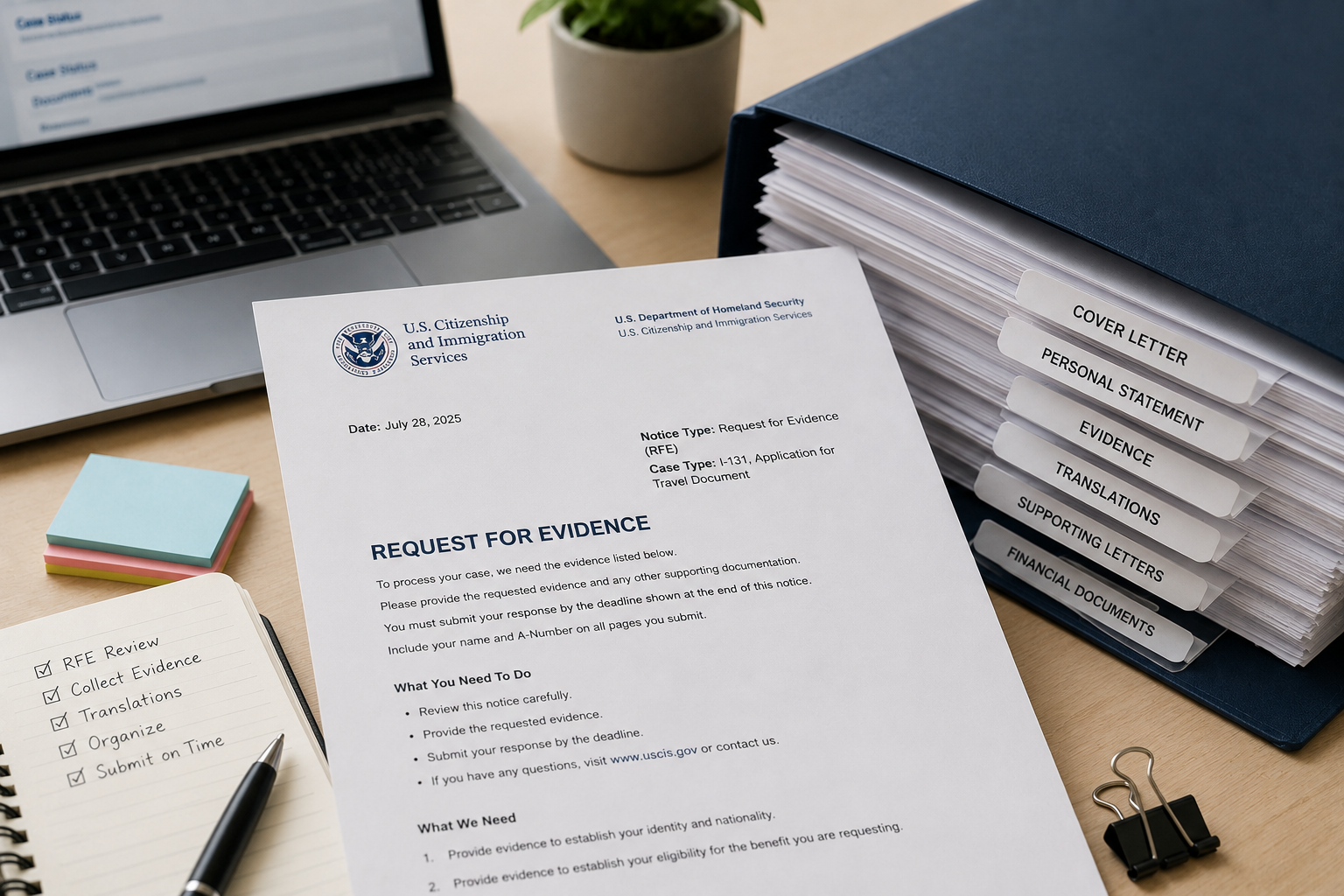
A Request for Evidence (RFE) is a notice USCIS may issue when additional documents, evidence, or information are needed to determine eligibility for the immigration benefit being requested.
However, there is one very important point applicants should understand:
USCIS is not required to issue an RFE in every case before making a decision.
Applicants should therefore not rely on the assumption that, “If something is missing, USCIS will simply ask me for it later.”
Depending on the circumstances of the case, USCIS may make a decision based on the evidence already contained in the record, including a denial without first providing another opportunity to submit missing evidence.
Effective August 5, 2025, USCIS updated its policy regarding the issuance of Requests for Evidence (RFEs) and Notices of Intent to Deny (NOIDs).
Under this policy, USCIS officers have discretion to determine whether an RFE or NOID is appropriate based on the facts and evidence in the individual case.
In certain circumstances, USCIS may deny a request without first issuing an RFE or NOID.
This can be particularly important when required initial evidence was not submitted with the application or petition, or when the evidence in the record does not establish eligibility for the requested immigration benefit.
For applicants, the practical takeaway is important:
Do not intentionally submit an incomplete case with the expectation that USCIS will necessarily give you another opportunity to provide the missing evidence.
Preparing a complete and properly supported submission from the beginning has become even more important.
Receiving an RFE does not automatically mean your case will be denied.
It means USCIS is requesting additional information or evidence before continuing its review of the case.
Read the entire RFE carefully, not only the list of requested documents.
Determine:
The RFE notice provides a deadline for responding.
Follow the date and instructions contained in your specific USCIS notice.
Do not wait until the last few days to begin preparing the response, especially if you need to obtain additional records, gather supporting evidence, or prepare certified English translations.
Missing the response deadline can have serious consequences for the case.
One common mistake is submitting a large volume of documents without first determining what USCIS is actually asking the applicant to establish.
More evidence does not automatically mean a stronger response.
A better approach is to break the RFE into individual issues and determine which documents or explanations directly respond to each one.
The response should be organized around the specific questions and deficiencies identified by USCIS.
Supporting documents should be organized so that the reviewing USCIS officer can easily understand how they relate to the RFE.
Whenever possible:
Before submitting the response, compare the completed package with the original RFE one more time.
Make sure every issue raised by USCIS has been addressed.
Documents submitted to USCIS in a foreign language must be accompanied by a complete English translation and the appropriate translator certification.
When preparing an RFE response, check both the underlying document and its translation before submission.
After receiving the response, USCIS continues reviewing the case.
What happens next depends on the type of application or petition and the individual circumstances involved.
If your case is connected to a USCIS online account, continue checking Case Status and the Documents section for additional notices or a decision.
An RFE gives an applicant an opportunity to provide additional evidence, but applicants should not assume USCIS will provide that opportunity in every case.
Depending on the circumstances, USCIS may make an unfavorable decision without first issuing an RFE or NOID.
For this reason, the initial filing should be prepared as completely and carefully as possible, with the required forms and supporting evidence included from the beginning.
If an RFE is issued, the response should be prepared based on the actual language of that USCIS notice and the individual circumstances of the case, rather than relying on a generic response template.

