Like everywhere else, we have cookies, too


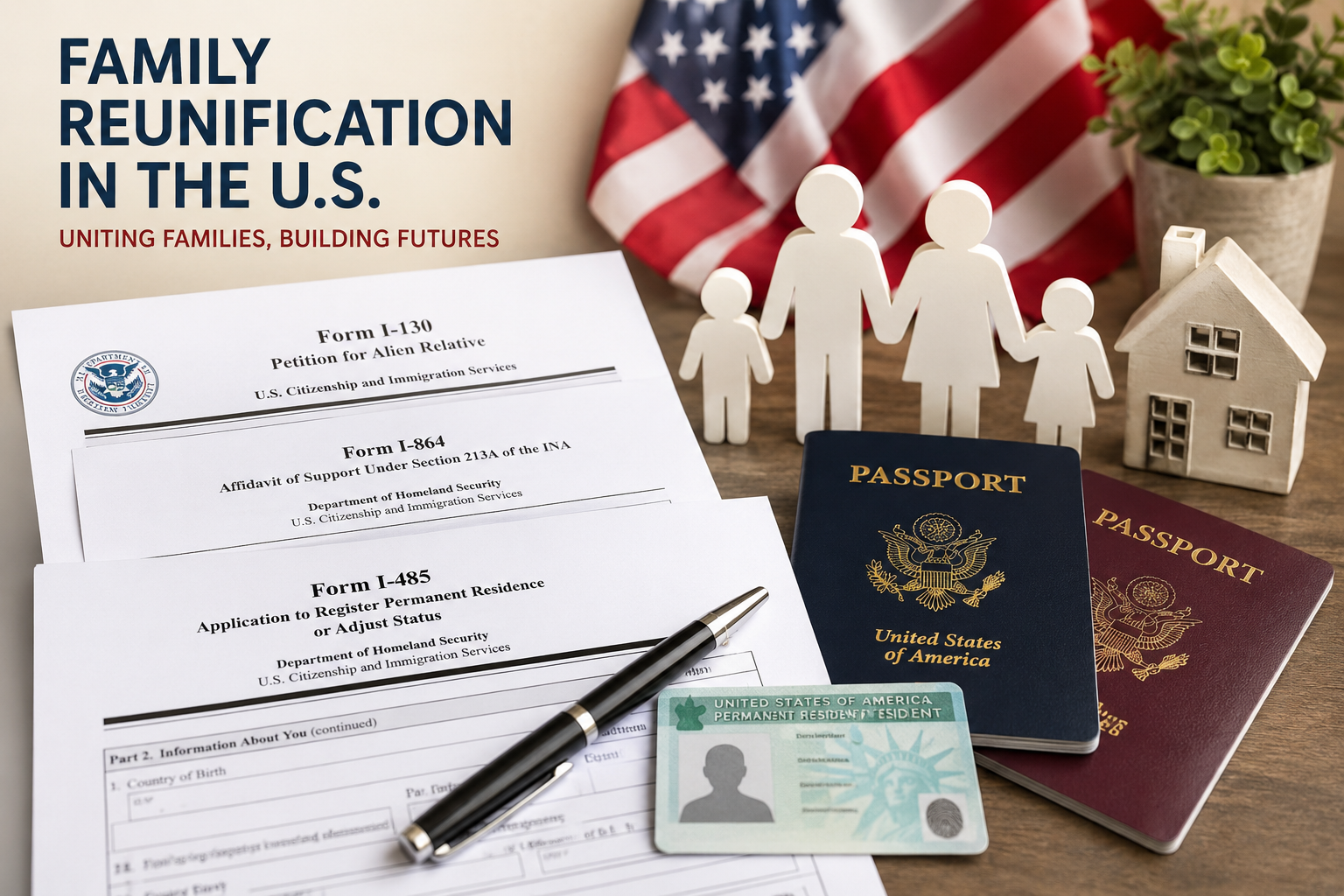
Family-based immigration is one of the primary pathways to permanent residence in the United States.
However, having a relative who is a U.S. citizen or Green Card holder does not automatically mean that a person is eligible to receive a Green Card.
The process depends on who is filing the petition, the relationship between the petitioner and beneficiary, the petitioner’s immigration status, the beneficiary’s immigration category, and whether the beneficiary is currently inside or outside the United States.
For many family-based immigration cases, the process begins with Form I-130, Petition for Alien Relative.
The relatives a person may petition for depend on whether the petitioner is a U.S. citizen or Lawful Permanent Resident (Green Card holder).
A U.S. citizen may generally file Form I-130 for:
A Lawful Permanent Resident may generally file for:
The options available to a permanent resident are more limited. For example, a Green Card holder cannot file a family-based I-130 for a married son or daughter.
This distinction is extremely important in family-based immigration.
Immediate Relatives of U.S. Citizens include:
Immigrant visas for Immediate Relatives are not subject to the annual numerical limits that apply to family preference categories.
Other qualifying family relationships fall within the Family Preference Categories, which are subject to annual numerical limits.
As a result, some beneficiaries may need to wait for an immigrant visa to become available before proceeding to the next stage.
For these categories, the Priority Date and the Department of State’s Visa Bulletin become particularly important.
This is one of the most commonly misunderstood parts of family immigration.
Approval of Form I-130 does not automatically give the beneficiary a Green Card.
Form I-130 is used to establish a qualifying family relationship and is generally only one part of the overall immigration process.
Filing or approval of an I-130 by itself does not automatically grant permanent resident status.
What happens next depends on several factors, including where the beneficiary is located, the applicable immigrant category, visa availability, and whether the beneficiary is eligible for the next step in the process.
In certain circumstances, the next step may be Adjustment of Status.
Adjustment of Status allows an eligible person who is already in the United States to apply for permanent resident status without completing immigrant visa processing at a U.S. consulate abroad.
The primary application used for this process is Form I-485, Application to Register Permanent Residence or Adjust Status.
In some cases, Form I-130 and Form I-485 may be filed concurrently when the applicant is eligible for Adjustment of Status and an immigrant visa is immediately available.
However, being physically present in the United States does not automatically mean that a person is eligible to file Form I-485.
The circumstances of the person’s entry into the United States, immigration history, current and previous status, immigrant category, visa availability, and other factors may affect eligibility.
If the beneficiary is abroad, the case will generally proceed through Consular Processing after the appropriate USCIS stage has been completed.
After approval of the I-130 and when the case is ready to proceed, it may be transferred to the National Visa Center (NVC) for further processing.
Depending on the case, this stage can include:
If the immigrant visa is approved, the beneficiary may then use that visa to seek admission to the United States as a permanent resident.
Many family-based immigration processes also require Form I-864, Affidavit of Support Under Section 213A of the INA.
The petitioner generally serves as the financial sponsor and must meet the applicable requirements.
If the petitioner’s income is insufficient, other options may be available in certain circumstances, such as qualifying household-member income or a joint sponsor, provided the applicable requirements are satisfied.
For this reason, the financial sponsorship portion of the case should ideally be evaluated before reaching the later stages of the immigration process.
A marriage certificate alone is not necessarily sufficient to establish eligibility in a marriage-based immigration case.
USCIS may require evidence demonstrating that the marriage is bona fide — meaning that the couple entered the marriage with the intention of establishing a genuine life together and not solely to obtain an immigration benefit.
Depending on the couple’s circumstances, evidence may include:
When filing Form I-130 for a spouse, Form I-130A, Supplemental Information for Spouse Beneficiary, is also generally required.
Not necessarily.
The rules regarding derivative beneficiaries depend on the immigration category.
In certain Family Preference Categories, the principal beneficiary’s spouse and qualifying unmarried children under 21 may be eligible to immigrate as derivative beneficiaries.
However, Immediate Relatives of U.S. Citizens do not have derivative beneficiaries.
As a result, separate Form I-130 petitions may be required for qualifying family members.
This is why it is important to determine the immigration category of each family member individually before filing.
There is no single processing time that applies to every family-based immigration case.
The timeline may depend on:
For Family Preference Categories, waiting for an immigrant visa to become available can be a significant part of the overall process.
For this reason, comparing your case to a friend’s or relative’s case may be misleading even when the situations appear similar.
Before beginning a family-based immigration process, it is important to determine:
Choosing the correct family-based immigration pathway before filing Form I-130 is important.
Form I-130 is often only the first step. What happens after filing or approval depends on the immigration category and the individual circumstances of each family.

